Tag: Latin American Literature

  • In the Time of Julia Alvarez

    Last night, as I was prepping my lesson, I reflected on the fact that there are three texts that I have taught for more years than any others: The Absolutely True Diary of a Part-Time Indian, Antigone, and In the Time of the Butterflies. It’s no coincidence that these are also among my absolute favorites, both to teach and as a reader myself. I’m teaching Butterflies right now in class, and in this sixth time through, while I rely on my approach from previous years, I am loving finding newness in this story.

    There is a scene at the end of chapter six in which Minerva is describing her journey from a meeting with Trujillo in the capital back to her home in the north of the country. Along the way, she describes the rain in each city she passes. Not only does this create a foreboding and depressive mood, I’ve always interpreted the rain as a motif for Trujillo’s absolute, oppressive control over the DR and its people.

    “We’ve traveled almost the full length of the island and can report that every corner of it is wet, every river overflows its banks, every rain barrel is filled to the brim, every wall washed clean of writing no one knows how to read anyway.”

    Out of curiosity, I opened up Google Maps and entered all of the place names Minerva describes on her trip home. Seeing her route up the autopista Duarte, the north-south spine of the Dominican Republic, gave fresh context to the totality of the rain, and by extension, Trujillo’s regime.

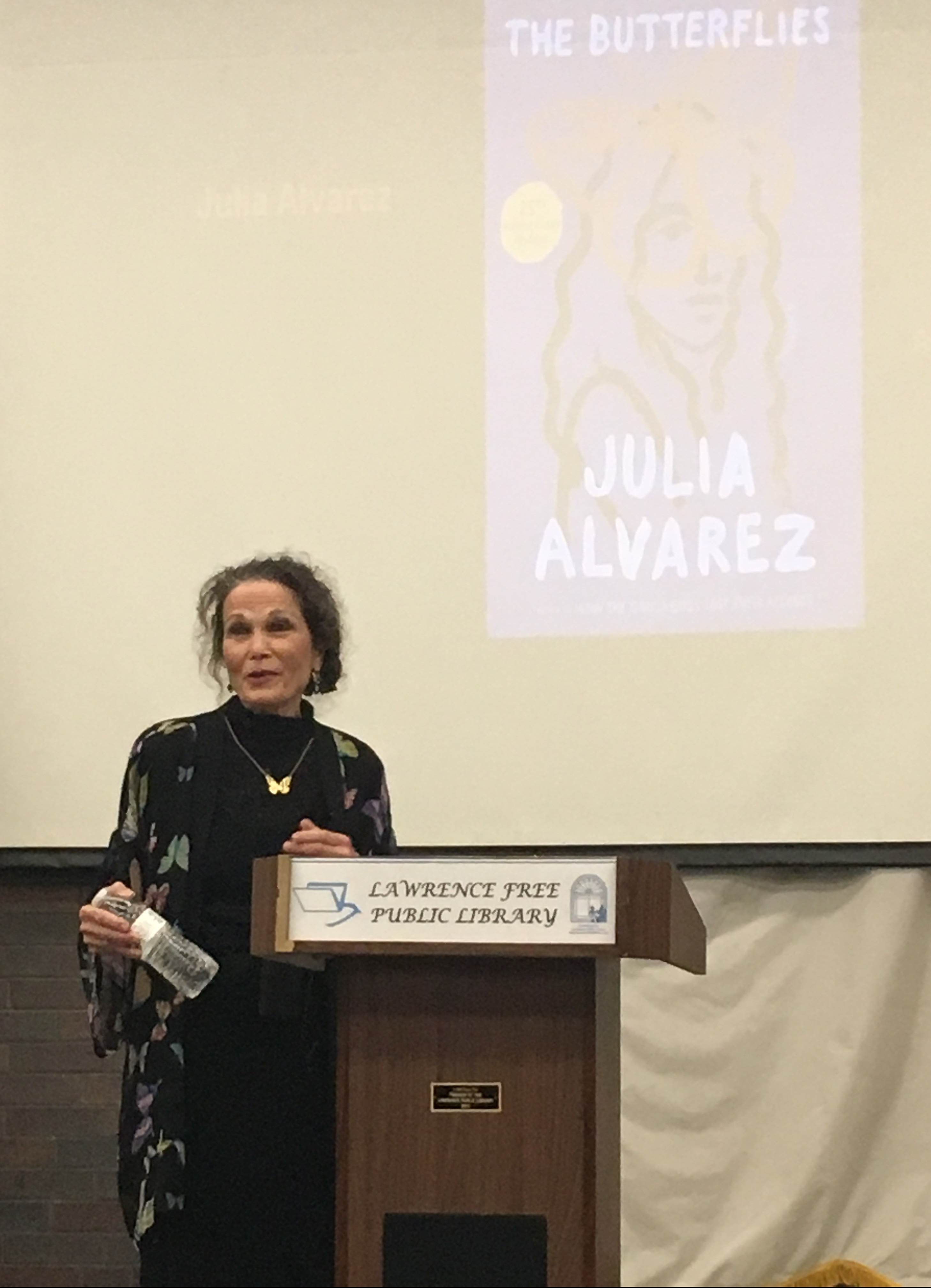
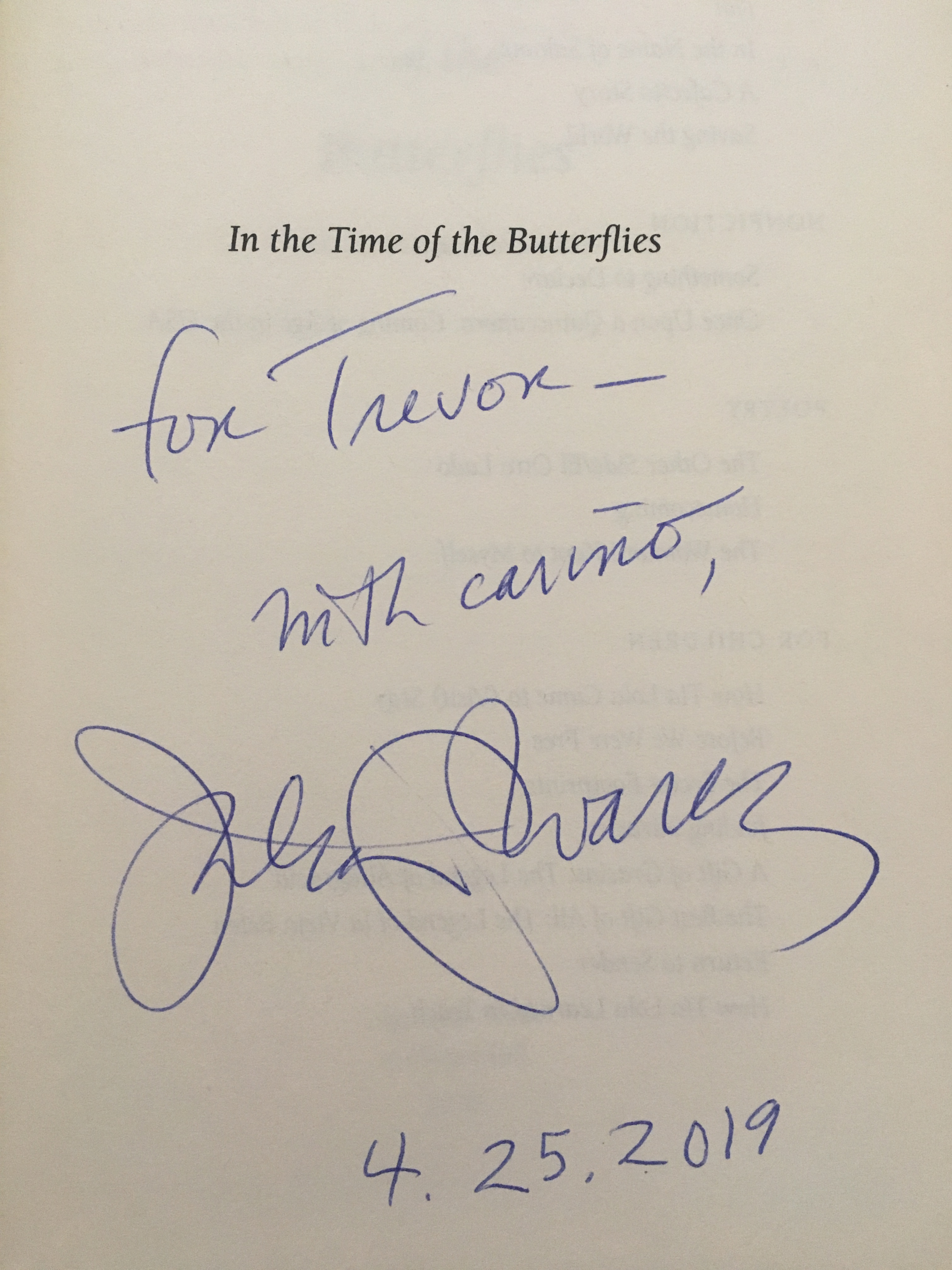
    A few weeks ago Julia Alvarez came to Lawrence, the city where I teach. Her visit coincided with the start of my Butterflies unit and I invited my students to attend her evening lecture at the public library. It has always been important to me that my students – most of whom are Dominican, like Alvarez – have access to their literary heritage. It’s more than simply curricular representation; rather, I strive to give them access to the nuances of Caribbean and Latin American literature and how history and identity have shaped a distinctive literary culture. In the same way that white students in the U.S. have internalized Eurocentric archetypes, plot structures, and literary features as an extension of Anglo history and culture, I want my Latinx students to be able to articulate what makes writing distinctly Dominican, Puerto Rican, Latin American, etc. The students who attended Alvarez’s lecture were enthralled to hear her describe the context that gave birth to her writing career because it is a context that is familiar to them. Many waited for over an hour after the lecture to meet Alvarez personally and get her autograph in their copies of In the Time of the Butterflies.

    As a relatively new student to Latin American literature myself, hearing Alvarez helped me broaden my own understanding of what makes her writing distinctively shaped by her lived experiences and the history of the Dominican people. Here are some of the most memorable things she said during her presentation:

    “I believe in the power of stories to change the world.”

    “One of the first things that happens in a dictatorship is that books are confiscated.”

    “I’m a human being. Nothing human is alien to us.”

    “Stories give you animo.”

    “I learned about storytelling from people who didn’t know how to read or write.”

    “When people ask: are you still writing? I respond: are you still breathing?”

    “Do what you love.”

    “Things you love are hard.”

    Finally – and notably – Alvarez also described that the first book she treasured as a child was 1,001 Nights. The core of her message about the power of stories was rooted in the lesson of Sheherezade’s persistence to change her fate through storytelling.

  • Modeling Lit Analysis with Audio

    In my neverending quest to find methods of modeling deep literary analysis with high transferability practice for students, I have recently started experimenting with some different lesson designs. In taking a cue from my STEM colleagues who rely on Khan Academy to do inverted lessons (when students learn the material independently and then teachers monitor the practice in class), I have started pre-recording my own guided analysis activities; then, in class, while students listen with headphones and answer questions about what they are learning, I can focus on what they are producing instead of on my delivery of the lesson. I like this format because it allows me to model for students what strong textual analysis looks like while also freeing up my focus and energy in class to focus exclusively on student understanding.

    There are a few criteria that guide this lesson format for me:

    1. Students need to have pre-read the text for homework. This includes completing their own annotations and thinking. If they didn’t complete the reading, they need to do so in class before they begin listening to the recording. I don’t spend a lot of time summarizing text or reading it for them on the recordings, so I need them to have a preliminary understanding of the text before they begin the analysis activity.
    2. Students can work at their own pace through the lesson, but they need to complete everything by the end of the period. While the recordings tend to be about ten minutes long, they are broken up by short questions throughout that they need to respond to before moving on. I make a companion worksheet for students to complete as they listen and cue them in the recording when to pause and answer questions. Their written answers allow me to assess in real time if students are understanding and pacing themselves well. If their response is accurate, I’ll silently give a check next to questions. If their response reveals some misunderstanding, I’ll ask the student to listen to a section of the recording again or do a quick reteach on the spot. In all, the lesson takes about 45-50 minutes for most students to complete.
    3. At the end of the activity, I ask students to synthesize what they have learned by responding to a longer written prompt. The prompt is frequently structured to push students’ thinking further than what they heard in any one part of the recording. This is vital because I still want students to be doing the intellectual heavy lifting; even though my analysis has raised the floor on how they might think about the text, I want them to use the interpretation I provide to go further than the clues I give them.

    In terms of preparation, it takes me about 45 minutes to write up a script for a ten-minute recording and then another 30 to record and make the corresponding worksheet. However, this prep time is invaluable in the classroom as it allows students to work at their own pace and I can focus all my energy in class on checking for their understanding (instead of delivering or guiding the lesson live).

    Overall, students like the format. I’ve asked for their feedback after each time I use this structure and it is generally positive.

    Here is an example of a full script I write for myself before recording.

    The materials for this lesson including the student worksheet, audio recording, and a magical realism reference sheet are available on my Teachers Pay Teachers store.

    This is a recorded activity to guide you through an analysis of Meat, by Virgilio Piñera, a Cuban writer who uses magical realism. As you listen, follow along and annotate your text. At certain points in the recording I will ask you to pause the recording and answer the questions on your worksheet. Do not go ahead in the recording until you have answered the required question.

    Let’s get started.

    In Meat, by Virgilio Piñera, the characters are forced to go to extreme measures because they are starving. The solution they find is to cut off, cook, and eat parts of their own bodies. When I see something that obviously is magical realism, since it does not make sense in the real world, I immediately start asking myself: what point is the author trying to make by introducing this magical element? In Gabriel García Márquez’s story, Light is Like Water, the magical realism is both a tribute to the relationship between a grandfather and his grandchildren as well as a warning about the power of the imagination. So, with Meat, we have to ask ourselves as we read: what point is the author trying to communicate to us by using magical realism? Pause the recording here and answer question number one on your worksheet.

    The magical realism is introduced at the beginning of paragraph 2. Take a careful look at these first two sentences in your text as I read them aloud: “Only Mr. Ansaldo didn’t follow the order of the day. With great tranquility, he began to sharpen an enormous knife and then, dropping his pants to his knees, he cut a beautiful fillet from his left buttock.” In these sentences, the magical and the ordinary are treated the same. In fact, look at the words used to describe what Mr. Ansaldo is doing. I first notice the word “tranquility” – he is clearly calm as he takes a knife and cuts off a piece of his own back side. Find one other word in this sentence that seems odd to use as part of this description of Mr. Ansaldo’s actions and reflects how the magical and ordinary are treated the same. Pause the recording while you find the word and write it on your worksheet under number two.

    The author, Virgilio Piñera, plays with verbal irony throughout the story. I’ll point out and explain one example and then I want you to look at another example on your own. Look about half-way through paragraph 2. Find the short sentence that says: “The facts were laid bare.” This is the author’s idea of a joke. This expression: the facts were laid bare, usually means the facts are obvious. But in this context, the word “bare” has a second meaning. In the sentence before, Mr. Ansaldo drops his pants and exposes his bare backside to his neighbor. The author is playing with language, using this verbal irony to remind readers of the absurdity of the story. He doesn’t want us to take this story too seriously. Now it’s your turn. Go look at the first sentence in paragraph 6. How is this sentence an example of verbal irony and what is the author’s purpose for including this? Pause the recording while you respond to question 3.

    One of the most interesting elements of this text for me is the relationship between the characters and their bodies. In the real world, our bodies are our part of our identity; they are who we are. They also must remain healthy enough for us to continue living in them. But in this story, the characters’ bodies become objects. They actually become meat, and technically, this is true of our bodies as well. At the end of the day we are animals like all others. Let’s talk for a minute about this word: meat. The story was originally written in Spanish and given the Spanish title, “La Carne.” In Spanish, the word carne means both animal meat AND the flesh of people. But in English, we would never use the word meat to describe human skin as carne is used in Spanish. The translated title makes this story almost horrifying to imagine as English speakers because we associate the word meat with animals and food. But the Spanish title, “La Carne,” plays with the double meaning of the word in a more subtle way since it can mean either food or human flesh. This is a great example of how the connotation of words can change in different languages and different contexts. Pause the recording while you answer question 4 about the title of this story.

    Aside from becoming meat, the characters’ bodies also become objects in another way. They become food. While we would normally be disturbed by the idea of eating our own bodies, the author makes this act something to be celebrated. In paragraph 1, the bodies begin as objects of starvation and suffering and by paragraph 2, they are transformed into a resource of nourishment and energy. In paragraph 3, Mr. Ansaldo teaches his neighbors how to cut meat off of their own bodies. Re-read paragraph 3 to the bottom of page 99; then find two phrases from this section of text that celebrate the discovery that the characters can eat their own flesh. Pause the recording while you re-read and answer question 5 on your worksheet.

    It is important to note that the most critical aspect of magical realism used in this story is that cause and effect are subjective. Eating your own body would be painful. Moreover, it actually destroys your body. And this brings us to the main situational irony of the story. Mr. Ansaldo and his neighbors are starving to death. Although eating their bodies solves the problem of starvation, it creates an equally – if not moreso – complicated problem of no longer having a body. Either path results in death. Given the absurd logic of this situation, we have to ask ourselves, what point is the author trying to make by using this magical realism?

    Here are some of my theories. As you listen, record my thoughts on number 6 on your worksheet.

    Eating your own body gives you control over a desperate situation. Starvation is a slow and painful way to die. It is also a passive way to die – it happens to you. By eating their own bodies, the characters are able to take active control over their destiny. That said, they seem unconcerned that this choice still results in their death. Which leads me to my next theory.

    Eating your own body is not meant to be taken literally; instead it is symbolic. Since the characters so easily embrace the act of eating themselves and don’t appear to be crazy, the story actually is trying to deliver a message about how people make choices that end up harming themselves. We are not meant to interpret “eating” as literal eating but rather figurative or symbolic eating. For example, people might smoke cigarettes knowing the damage they can do to their lungs. By smoking, they are harming their health in a similar way that the characters in the story are destroying themselves. Pause the recording and answer question 7.

    For this final part of the recording, please follow along with number 8 on your worksheet and fill in the blanks as you hear them.

    Whenever we see magical realism in a text, we should always be asking ourselves: What point is the author trying to make? Magical realism often is used to highlight the irony of a situation. It also forces us to look at a situation in a new way because we see the magic that the characters in the story do not.

    This is the end of the recording. Please finish responding to the questions on your worksheet and then follow directions on the board.
     

  • Lunequisticos

    After 15 years teaching English, it is a rare thing to walk into class feeling confounded by the text I am teaching. On a whim I had selected to include Victor Hernandez Cruz’s Lunequisticos in my short literary unit on Latin American identity and diaspora; without reading too closely, it clearly deals with the dissonance of bilingual and bi-cultural identity. It wasn’t until the days leading up to the lesson when I began prepping that I realized what I had gotten myself into:

    –A poem filled with intentional incoherence in both English and Spanish.

    –My eighth grade students who – on some days – view poetry as a confounding literary torture device thrust upon them against their will for the sole purpose of reminding them how much school sucks. It is worth pointing out that a significant number of my students are English language learners, some of whom have only been speaking English for two years, so English class can feel – understandably – overwhelming.

    –My own unfamiliar anxiety as I rehearsed my lesson opening: “I’m not really sure what this poem is about.” In experiencing this sensation I concluded that at least some part of my success as a teacher must come from my otherwise well-practiced ability to say something interesting about texts and thereby sound competent enough to ask my students to listen to me.

    But there it was on page 15 of the text packet I had assembled for them: the poem that was sure to cause my destruction as an English teacher.

    Lunequisticos

    In what language do you jump off one boat
    to get to another one to buy something cold
    to drink while at the same time you contemplate
    The shapes and curves of the eyes the various
    family trees have produced in all the people
    present buying something cold to drink
    The shades of minds each beaming glaze of their
    spirit all being here for a second of my questions
    I am in the young woman’s tenor her lips drum
    pictures of thin Spanish fans waving
    Ships sailing in pictures hanging on living
    room walls  Chaotic room of thirsty tongues
    Moving my whistle sounds to investigate
    Each glassy eyes my windows
    Their fires in the cold drinks
    So if you ask my creature friends in what language
    do I ask the question to come in: Do I take my
    Oye/lo/que/one/time/eva/or/iva/decir/que/uno/una
    ves/sepuso/la/cosa/de bullets/peor que/one guerra
    en/the/escuela/corner/de/maestros/ya/con/lisencia
    y/todo/una/mes/mass/de/masas/tambien/con/masa/cuando
    ella/pasaba/lo/profesores/le/cantaban/siquiere/gozar
    ben/a/bailar/tengo/libros/de/to/colores/estudiaremos
    el/at/most/feat/el/turn/de/una/language/como/hace/in
    side/the/mind/calculate/while/it/separates/words/in/two
    languages/sounds/spellings/systems/whole/tone/latitude
    and/altitude/altiduego of voces/in/gas/communications/gets
    filtered/and/ironed/tambien/the/two/musics/through/one/breath
    Para/
    Or do I spray it around in straight talk
    Filtar: Presuming you tailored the rough edges of your
    tenor  dress it up with my wave of syllables say to me
    What is your idea what flavor did you ask for
    In what tense does it remain the same color when it
    laughs in your cup.
    Pure orange juice.
    Pure ginger root-boiled.
    Pure grapefruit – the ones with freckles.
    Pure Spanish/Pure English
    Pure tunes tos tono tos tones
    When is exactly Saturday and Sabado two different nights
    Do you say in one aspect of the night your deep feelings
    to whoever might be involved in a need to hear them from
    you or do you avoid what’s really going on and talk other
    heavens go over to the jukebox before ordering a cold
    drink put on Tito Rodriguez’s “Double Talk” put the boat
    In reverse and relax you have just given birth to twins
    The tongue figures out how not to jump from one boat to
    another and takes a dash out onto the street where the
    wrong speed can brake anybody’s record.

    My frantic online searches for scholarly analysis about this poem yielded little: a one-line note on one site about the intersection of power and language. The Norton Anthology of Latino Literature, where I originally found the poem, points out “…the sounds and structures of Spanish and English collide to produce a downpour of rhythmic code switching, chaotically defying the notion of linguistic purity.” Helpful, but, I still could not figure out the meaning of the title (moon? lunatic? linguistics?), let alone interpret the bilingual jumble (or as one of my students ended up calling it, the “word bank”) in the middle of the poem. I asked friends and colleagues who are native Spanish speakers to  help me make sense of the poem. We all agreed that it was intentionally meant to confound, but struggled to find a cohesive story to tell about the poem that would make sense to 14-year-olds.

    So I swallowed my pride, walked into class, and said, “Today we are going to read a poem that is probably going to make your brain melt a little. It certainly made mine melt. But let’s ask lots of questions of each other and the text and see where it takes us.” If anything, this reminder that curiosity is really the best approach to literature – especially rigorous texts – was my most significant realization from this lesson. Wondering is a better starting point than knowing and for all our talk of proficiency and testing, this alone was a useful moment for me.

    I started by reading the poem aloud to students. And there was brain melting. A lot of it. But then, something pretty awesome happened as we re-read, wrote, discussed. This poem got inside everyone in the room. They could not stop thinking about it, talking about it, re-reading it. They translated pieces of it into English and then into Spanish and back into English. I had intentionally given them a chance to opt out of this poem by giving them a homework assignment that allowed them to choose this or another, more accessible poem we had just read to analyze; the vast majority of students chose Lunequisticos. One student reported that he had sat down with his Spanish-speaking mother and made her read it with the hope that she would find something we missed in class. After class I caught them examining the poem during their free time. And I don’t just mean the students who will always go above and beyond; everyone from the kid who too frequently zones out in class to the one who claims, “It’s not personal but I’m just bored in your class, Mister.” They were hooked.

    A few observations were especially interesting to me.

    One of most interesting moments of the lesson came when one of my more fluent, bilingual readers volunteered to read the poem. When he came to the second line in the “word bank” he read, “ves/sepuso/la/cosa/de bullets/peor que/una guerra… wait… unauna guerra/en/the/escuela…” Instead of reading “one guerra,” as the author wrote it, he instinctively translated it into the Spanish, caught himself making the mistake, and then “corrected” himself without actually reading the line correctly. It happened in a second, but seemed to shine a brilliant light on Hernandez Cruz’s design of the poem and his point about the power and dissonance inherent in language, translation, and bilingualism.

    Another of my ELL students, relatively newer to English than others in my class pointed out that, just like in the poem, Spanish and English are frequently battling to make meaning in his head: “This is what it feels like in my brain all the time, Mister.”

    What I learned to love about the poem over the course of this lesson was that there is so much to unpack that – rather than be totally inaccessible to middle schoolers in general – it gave everyone, despite their range of reading levels from third through twelfth grade, something to notice. Some students were fascinated by the ways in which Hernandez Cruz uses both Spanish and English. Others quickly caught the metaphor of jumping from one boat to another and the symbolism of the drink. Still others focused on repeated words in the text: tenor, pure, eyes, tongue. Or the (intentionally?) misspelled words or awkward constructions: uno/una/ves/sepuso, siquere, brake.

    Many students immediately saw connections to other texts we had read in class that I, in my panic to understand the poem, had initially missed. In Lunequisticos, they saw echoes of Julia Alvarez who describes the in-between-ness of learning English, in Entre Lucas y Juan Mejía, as “frightening” when she realized, “I began losing my Spanish before getting a foothold in English. I was without a language.” They compared the confusion and dissonance in Lunequisticos to the “…slow scream across a yellow bridge,” and the idea of being “cast out from the new paradise” in Juan Felipe Herrera’s Exiles. And they pointed out the parallel idea of language and place as a proxy for a sense of belonging when they compared “jump[ing] off one boat to  get to another one” and, “No nací in Puerto Rico/Puerto Rico nacío en mi,” from María Teresa Fernández’s Ode to the Diasporican.

    Lunequisticos got under our skin in the way good writing should. It left us with more questions than answers. It spoke to the complexity of my students’ experiences as Latin@, as Spanish-speakers, as English-speakers, as bi-cultural. And, at least on some level, I’m sure that some of my students connected with this poem as teenagers out of a desire to understand its complexity as all teens want their own complexity to be seen, honored, and understood.

    We still haven’t figured out what the title means.

Something went wrong. Please refresh the page and/or try again.