Tag: Teaching

  • Tales from the Chihuahuan Desert

    Gloria Anzaldúa ends the first poem in Borderlands/La Frontera, “This is her home / this thin edge of / barbwire.” This image reflects where my students live, both metaphorically and physically. They exist between spaces they did not choose or create, and they are defined by the struggle they experience as they make sense of the real and imagined borders around them. In watching them navigate this, I have realized that my role is to engage my students with the narratives that honor their Latinx identity and history. Attending the NEH Tales from the Chihuahuan Desert program will allow me to build a deeper understanding of how the Chicano experience on the border fits into the larger narrative and legacy of the Americas and find ways to convey this knowledge to my Latinx students who are hungry for their cultural birthright.

    Since, in many ways, young people exist on the “thin edges” of their world, they are naturally inclined to test the social, political, physical, and moral borders around them as they make sense of their identities and power; they are more naturally at home in the borderlands. By nature of their burgeoning sense of self and their place in society, young people are what Anzaldúa calls “the prohibited and forbidden [who] are [the] inhabitants” of the borderlands. As their teacher, I have the unique opportunity to witness as my students define and break the borders around them and to act as a guide for how they choose to live in the borderlands of their world.

    I first came to Gloria Anzaldúa a few years ago while researching for a survey unit I teach on the legacy of Latin American writers. While traveling in Colombia I heard about and saw the literary legacy of Gabriel García Márquez everywhere I turned. As a white man and English teacher who grew up in the U.S. education system, I was personally struck by a literary tradition that had little resemblance to the one I knew. Moreover, I thought of my students and the literary traditions they left behind when they moved from their home countries to the United States.

    For the past six years, I have taught eighth grade English at a public middle school in Lawrence, Massachusetts. All of my students identify as Latinx or Hispanic; most have Dominican or Puerto Rican heritage, and nearly all of them were born outside of the United States. Although the prevailing ideas about English curriculum in the U.S. education system are still largely rooted in antiquated assimilationist-era or neo-colonial ideas about “the canon,” my time in Colombia helped me recognize that I have an ethical responsibility as a teacher of bilingual Latinx students to share with them their literary and artistic birthright.

    While I had always included many writers and protagonists of color in my curriculum, I realized that representation is not enough. My students from Dominican Republic, Puerto Rico, Colombia, Ecuador, Guatemala, and El Salvador had rarely been exposed to the rich literary legacy of their homelands or of their people. Furthermore, as first-generation students in the U.S. school system, they have little chance of encountering this heritage. Alvarez, Neruda, Martí, Medina, Cortázar, Piñera, Thomas, Asturias, Esquivel, Ortiz Cofer, Anzaldúa, and García Márquez simply are not taught, and most bafflingly, might be considered too advanced for language learners and students reading below grade level; nearly all of my students fit into one or both of these categories. And yet, when I went to work assembling this curriculum – this head-first dive into my students’ own ancestral literary history – the texts brought my students to life. Suddenly they saw in these narratives their own struggles and passions held up like a mirror in front of them. They were devouring texts written three or four grades above their reading levels.

    While I acted as their literary guide through the richness of the language and technique of the writers, my students were my cultural interpreters, describing how Victor Hernández Cruz perfectly captures the cognitive dissonance of bilingualism in his chaotic poem, Lunequisticos, or how they viscerally feel the historical and contemporary “paradox of brownness” Richard Rodriguez describes in Brown: The Last Discovery of America. They hotly debate Rodolfo Gonzáles’ I Am Joaquín amongst each other: how can he be Joaquín and Cuauhtémoc and Cortes? And they extend this question to themselves: how can I be Spanish and Taíno and African, the conqueror and the conquered? How can I exist in this borderland between my identities?

    Although notably, few of the students in my school have known Mexican or Chicano ancestry, the symbol of the border has become a central image for my students as they make sense of all Latin American writing. They also viscerally feel as if they are caught up in the national dialogue about the U.S.-Mexican border; while most of them are unabashedly proud of their Dominican identity, they all share the experience of being seen as brown-skinned and heard as Spanish-speaking, and many people they encounter in the U.S. assume these equate to Mexican. So my students are curious not only about the symbolism of borderlands, which they feel intuitively in their own way, but the plight of the people who live in the real borderlands, with whom they are frequently conflated. Since the context of Chicano culture is relatively distant for both my students and me, expanding my understanding by immersing myself in the narratives and customs of its people would have a profound impact on my classroom and my ability to make the borderlands and Chicano history a more salient aspect of Latinx identity for my students.

    Deepening my own knowledge about this region, the people who experience the borderlands, and the culture and art that springs from it will allow me to better guide my students’ curiosity about their shared mestizo and trigueño experience and history. While I have done a fair amount of learning about Latin American writers and hope to contextualize the work I would do at the NEH institute within the broader field of Latin American literature, the reality is most of what I know on this topic is self-taught. As much as I have learned on my own, the opportunity to engage with issues of Latinx identity, binationalism, and bilingualism in an academic setting with leaders in the field – particularly those whose lived experiences as Latinx people have shaped their thinking – would help bring greater coherence to my curriculum and confidence to my instruction. I am particularly excited about the broad variety of opportunities to learn from so many different experts as well as the chance to do so in a group of similarly minded teachers, with whom I hope to discuss, debate, and share. I have found that my most rewarding professional experiences come when I have the opportunity to participate in an intellectual experience with others who are learning alongside me. I place a high premium on cultivating relationships with others to the end that we may mutually benefit from deep intellectual connections and shared trust. If I were selected to participate in the Tales from the Chihuahuan Desert program, I would be bringing 14 years of experience in an English classroom and at least an introductory context for examining the narratives, cultural artifacts, and landmarks presented in the program.

    The deeper I am able to immerse myself in this field of study, the more effectively I will be able to teach from a place of understanding and empathy. While I will never fully experience the world in the way my students do, ultimately, as best as I am able to, I want to see and feel “this thin edge of barbwire” so that I can better comprehend the lived experiences of my students who make their own homes in the borderlands of the world around them.
  • Modeling Lit Analysis with Audio

    In my neverending quest to find methods of modeling deep literary analysis with high transferability practice for students, I have recently started experimenting with some different lesson designs. In taking a cue from my STEM colleagues who rely on Khan Academy to do inverted lessons (when students learn the material independently and then teachers monitor the practice in class), I have started pre-recording my own guided analysis activities; then, in class, while students listen with headphones and answer questions about what they are learning, I can focus on what they are producing instead of on my delivery of the lesson. I like this format because it allows me to model for students what strong textual analysis looks like while also freeing up my focus and energy in class to focus exclusively on student understanding.

    There are a few criteria that guide this lesson format for me:

    1. Students need to have pre-read the text for homework. This includes completing their own annotations and thinking. If they didn’t complete the reading, they need to do so in class before they begin listening to the recording. I don’t spend a lot of time summarizing text or reading it for them on the recordings, so I need them to have a preliminary understanding of the text before they begin the analysis activity.
    2. Students can work at their own pace through the lesson, but they need to complete everything by the end of the period. While the recordings tend to be about ten minutes long, they are broken up by short questions throughout that they need to respond to before moving on. I make a companion worksheet for students to complete as they listen and cue them in the recording when to pause and answer questions. Their written answers allow me to assess in real time if students are understanding and pacing themselves well. If their response is accurate, I’ll silently give a check next to questions. If their response reveals some misunderstanding, I’ll ask the student to listen to a section of the recording again or do a quick reteach on the spot. In all, the lesson takes about 45-50 minutes for most students to complete.
    3. At the end of the activity, I ask students to synthesize what they have learned by responding to a longer written prompt. The prompt is frequently structured to push students’ thinking further than what they heard in any one part of the recording. This is vital because I still want students to be doing the intellectual heavy lifting; even though my analysis has raised the floor on how they might think about the text, I want them to use the interpretation I provide to go further than the clues I give them.

    In terms of preparation, it takes me about 45 minutes to write up a script for a ten-minute recording and then another 30 to record and make the corresponding worksheet. However, this prep time is invaluable in the classroom as it allows students to work at their own pace and I can focus all my energy in class on checking for their understanding (instead of delivering or guiding the lesson live).

    Overall, students like the format. I’ve asked for their feedback after each time I use this structure and it is generally positive.

    Here is an example of a full script I write for myself before recording.

    The materials for this lesson including the student worksheet, audio recording, and a magical realism reference sheet are available on my Teachers Pay Teachers store.

    This is a recorded activity to guide you through an analysis of Meat, by Virgilio Piñera, a Cuban writer who uses magical realism. As you listen, follow along and annotate your text. At certain points in the recording I will ask you to pause the recording and answer the questions on your worksheet. Do not go ahead in the recording until you have answered the required question.

    Let’s get started.

    In Meat, by Virgilio Piñera, the characters are forced to go to extreme measures because they are starving. The solution they find is to cut off, cook, and eat parts of their own bodies. When I see something that obviously is magical realism, since it does not make sense in the real world, I immediately start asking myself: what point is the author trying to make by introducing this magical element? In Gabriel García Márquez’s story, Light is Like Water, the magical realism is both a tribute to the relationship between a grandfather and his grandchildren as well as a warning about the power of the imagination. So, with Meat, we have to ask ourselves as we read: what point is the author trying to communicate to us by using magical realism? Pause the recording here and answer question number one on your worksheet.

    The magical realism is introduced at the beginning of paragraph 2. Take a careful look at these first two sentences in your text as I read them aloud: “Only Mr. Ansaldo didn’t follow the order of the day. With great tranquility, he began to sharpen an enormous knife and then, dropping his pants to his knees, he cut a beautiful fillet from his left buttock.” In these sentences, the magical and the ordinary are treated the same. In fact, look at the words used to describe what Mr. Ansaldo is doing. I first notice the word “tranquility” – he is clearly calm as he takes a knife and cuts off a piece of his own back side. Find one other word in this sentence that seems odd to use as part of this description of Mr. Ansaldo’s actions and reflects how the magical and ordinary are treated the same. Pause the recording while you find the word and write it on your worksheet under number two.

    The author, Virgilio Piñera, plays with verbal irony throughout the story. I’ll point out and explain one example and then I want you to look at another example on your own. Look about half-way through paragraph 2. Find the short sentence that says: “The facts were laid bare.” This is the author’s idea of a joke. This expression: the facts were laid bare, usually means the facts are obvious. But in this context, the word “bare” has a second meaning. In the sentence before, Mr. Ansaldo drops his pants and exposes his bare backside to his neighbor. The author is playing with language, using this verbal irony to remind readers of the absurdity of the story. He doesn’t want us to take this story too seriously. Now it’s your turn. Go look at the first sentence in paragraph 6. How is this sentence an example of verbal irony and what is the author’s purpose for including this? Pause the recording while you respond to question 3.

    One of the most interesting elements of this text for me is the relationship between the characters and their bodies. In the real world, our bodies are our part of our identity; they are who we are. They also must remain healthy enough for us to continue living in them. But in this story, the characters’ bodies become objects. They actually become meat, and technically, this is true of our bodies as well. At the end of the day we are animals like all others. Let’s talk for a minute about this word: meat. The story was originally written in Spanish and given the Spanish title, “La Carne.” In Spanish, the word carne means both animal meat AND the flesh of people. But in English, we would never use the word meat to describe human skin as carne is used in Spanish. The translated title makes this story almost horrifying to imagine as English speakers because we associate the word meat with animals and food. But the Spanish title, “La Carne,” plays with the double meaning of the word in a more subtle way since it can mean either food or human flesh. This is a great example of how the connotation of words can change in different languages and different contexts. Pause the recording while you answer question 4 about the title of this story.

    Aside from becoming meat, the characters’ bodies also become objects in another way. They become food. While we would normally be disturbed by the idea of eating our own bodies, the author makes this act something to be celebrated. In paragraph 1, the bodies begin as objects of starvation and suffering and by paragraph 2, they are transformed into a resource of nourishment and energy. In paragraph 3, Mr. Ansaldo teaches his neighbors how to cut meat off of their own bodies. Re-read paragraph 3 to the bottom of page 99; then find two phrases from this section of text that celebrate the discovery that the characters can eat their own flesh. Pause the recording while you re-read and answer question 5 on your worksheet.

    It is important to note that the most critical aspect of magical realism used in this story is that cause and effect are subjective. Eating your own body would be painful. Moreover, it actually destroys your body. And this brings us to the main situational irony of the story. Mr. Ansaldo and his neighbors are starving to death. Although eating their bodies solves the problem of starvation, it creates an equally – if not moreso – complicated problem of no longer having a body. Either path results in death. Given the absurd logic of this situation, we have to ask ourselves, what point is the author trying to make by using this magical realism?

    Here are some of my theories. As you listen, record my thoughts on number 6 on your worksheet.

    Eating your own body gives you control over a desperate situation. Starvation is a slow and painful way to die. It is also a passive way to die – it happens to you. By eating their own bodies, the characters are able to take active control over their destiny. That said, they seem unconcerned that this choice still results in their death. Which leads me to my next theory.

    Eating your own body is not meant to be taken literally; instead it is symbolic. Since the characters so easily embrace the act of eating themselves and don’t appear to be crazy, the story actually is trying to deliver a message about how people make choices that end up harming themselves. We are not meant to interpret “eating” as literal eating but rather figurative or symbolic eating. For example, people might smoke cigarettes knowing the damage they can do to their lungs. By smoking, they are harming their health in a similar way that the characters in the story are destroying themselves. Pause the recording and answer question 7.

    For this final part of the recording, please follow along with number 8 on your worksheet and fill in the blanks as you hear them.

    Whenever we see magical realism in a text, we should always be asking ourselves: What point is the author trying to make? Magical realism often is used to highlight the irony of a situation. It also forces us to look at a situation in a new way because we see the magic that the characters in the story do not.

    This is the end of the recording. Please finish responding to the questions on your worksheet and then follow directions on the board.


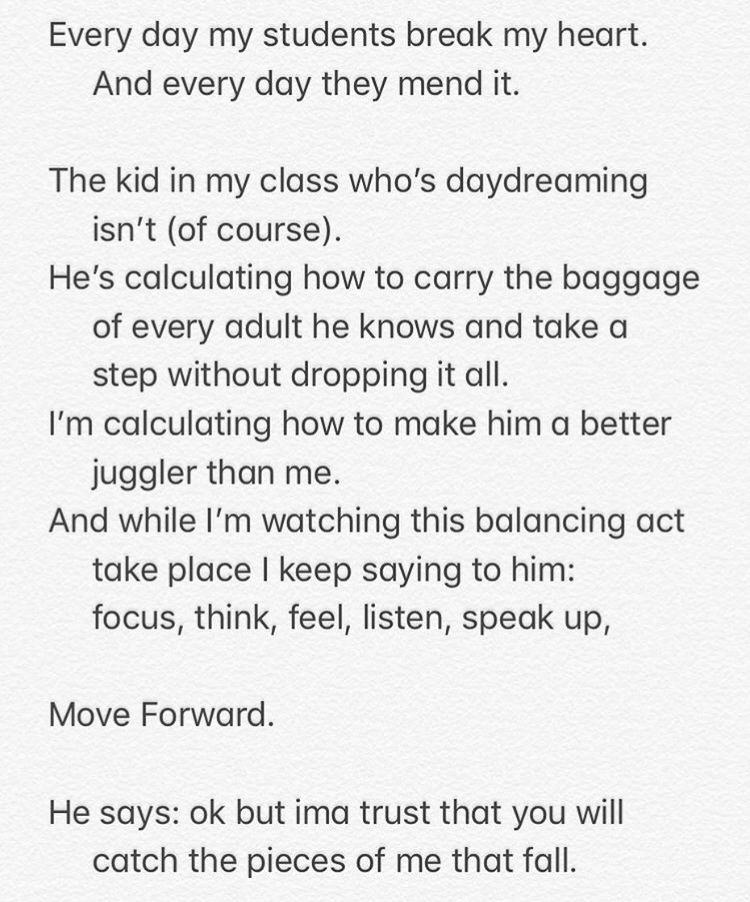
  • Catch the pieces

    A poem I scribbled in the notes of my phone while sitting on my front porch on a spring afternoon. Inspired by two students who put their trust in me.

  • Another “crazy” woman

    “My mom gets crazy when I’m not doing well in school.” -14-year-old student

    This week I turned my class’s attention to the idea of critical theory and specifically the concept of reading a text with a feminist lens. While some may argue that middle school is too early to do this, I have increasingly found that critical theory adds nuance to students’ thinking by providing them an avenue through which they can interpret text. Simply asking students what they see in a text generates a broad range of response, some of which are more helpful at moving their thinking forward than others. While there are tasks that are appropriate for this open-ended approach, I find that students benefit from going through a text with an analytical framework and a distinct set of vocabulary through which they can explore, critique, and understand a text.

    We’re reading Antigone. Notably, I went back to using the Robert Fagles translation this year after two years trying Seamus Heaney’s. The Fagles translation, published in 1982, is replete with the pathos that I associate with Greek tragedy and students immediately draw comparisons to the more melodramatic telenovelas that some are more willing than others to admit they watch. Aside from the richness of the language, what I also like about Fagles’ Antigone is that it provides an accessible opportunity for students to see the gender dynamics that are inherent. As a Greek woman, Antigone acts out of a duty to her oikos. As a powerful Greek man, Creon is obsessed with the polis. The play is as much about the two characters as it is about restoring the balance to the oikos and polis of Thebes, both of which have been thrown into disarray as a result of the fate of Oedipus, the war between Polynices and Eteocles, and subsequently, Creon’s ill-fated inheritance of the city and denial of burial rites to Polynices. One of the ways Creon’s brand of hubris plays out in the story is that his objections to Antigone take on distinctively misogynist overtones.

    However, it was one of the more subtle examples of misogyny as opposition to Antigone that later provided an opportunity to challenge the casual misogyny that we all experience today. When Antigone is brought before Creon for the first time, the Chorus tries to make sense of the revelation that she is to blame for burying the body of Polynices and breaking Creon’s law (lines 417-424):

    Here is a dark sign from the gods —
    what to make of this? I know her,
    how can I deny it? That young girl’s Antigone!
    Wretched, child of a wretched father,
    Oedipus. Look, is it possible?
    They bring you in like a prisoner —
    why? did you break the king’s laws?
    Did they take you in some act of mad defiance?

    The subtle misogyny is easy to miss without an understanding of the historical and cultural context of describing woman as mad or hysterical. This is not a new phenomenon but rather one that is part of all patriarchal agrarian societies; it was the ancient Greeks, after all, who coined the term hysteria. We talked as a class about the inherent problem of assuming that Antigone is motivated solely by emotional rebellion; this assumption is rich with irony given the moral high ground on which Antigone stands at this moment in the play. It has always been the easiest dismissal of women to call them mad.

    But this point became most salient to one of my students outside of class later in the day. He approached me with concern about his grades and behavior. Since he is a strong student and earnest in his behavior most of the time, I asked why he was concerned. With the close of the quarter and upcoming parent conferences he said, “I want to be sure everything is good because my mom gets crazy when I’m not doing well in school.” It was a casual comment that I’m certain most 14 year old boys have said about their mothers at one time or another. Even though I know this student has a strong relationship with his mother, I knew instantly I had to point out his word choice. I asked, “Your mother loves you enough to want to make sure you’re successful in school, right?” He nodded. “But you’re a male who just called his mother’s expression of her love for you crazy.” His eyes immediately widened and he let out an audible gasp as he quickly realized the connection I was making.

    The moment was easy enough for me to point out given the relevance to the day’s earlier lesson. But it has since had me reflecting more on the casual misogyny that exists all around us and how it enters my own language. This student was mature and reflective enough to have realize his mistake. I am acutely aware of the disparity between how confident my male students use their voices in class and how silenced my female students can feel. While I actively try to create space for female voices and quieter voices, I realize more needs to be done on this front. A few thoughts that feel most salient to me:

    1. It’s not just about my actions to create a classroom where all students develop a strong sense of voice; I need to teach students to be aware of how their gender influences the way their voices are perceived and valued so that they can do this work for themselves.
    2. As a male teacher, I must model for my male students the ability to be silent for the express purpose of giving female voices space. Similarly, I must model how to disagree without dominating.
    3. It is inevitable that casual misogyny will come up in the classroom. Given this, I must be more aware of how I play a role in ensuring it does not go unaddressed.

    The student with whom I had this interaction was gracious and mature about my response to him. While I know it won’t always go that way, it gives me comfort to know that English class is doing exactly what I believe so strongly it has the power to do: reading good books makes us better at living our lives. The fact that it was a 2,500-year-old Greek tragedy that created an opportunity for this reflection to occur for my 14-year-old student and for me is what I most love about teaching English.

  • Lunequisticos

    After 15 years teaching English, it is a rare thing to walk into class feeling confounded by the text I am teaching. On a whim I had selected to include Victor Hernandez Cruz’s Lunequisticos in my short literary unit on Latin American identity and diaspora; without reading too closely, it clearly deals with the dissonance of bilingual and bi-cultural identity. It wasn’t until the days leading up to the lesson when I began prepping that I realized what I had gotten myself into:

    –A poem filled with intentional incoherence in both English and Spanish.

    –My eighth grade students who – on some days – view poetry as a confounding literary torture device thrust upon them against their will for the sole purpose of reminding them how much school sucks. It is worth pointing out that a significant number of my students are English language learners, some of whom have only been speaking English for two years, so English class can feel – understandably – overwhelming.

    –My own unfamiliar anxiety as I rehearsed my lesson opening: “I’m not really sure what this poem is about.” In experiencing this sensation I concluded that at least some part of my success as a teacher must come from my otherwise well-practiced ability to say something interesting about texts and thereby sound competent enough to ask my students to listen to me.

    But there it was on page 15 of the text packet I had assembled for them: the poem that was sure to cause my destruction as an English teacher.

    Lunequisticos

    In what language do you jump off one boat
    to get to another one to buy something cold
    to drink while at the same time you contemplate
    The shapes and curves of the eyes the various
    family trees have produced in all the people
    present buying something cold to drink
    The shades of minds each beaming glaze of their
    spirit all being here for a second of my questions
    I am in the young woman’s tenor her lips drum
    pictures of thin Spanish fans waving
    Ships sailing in pictures hanging on living
    room walls  Chaotic room of thirsty tongues
    Moving my whistle sounds to investigate
    Each glassy eyes my windows
    Their fires in the cold drinks
    So if you ask my creature friends in what language
    do I ask the question to come in: Do I take my
    Oye/lo/que/one/time/eva/or/iva/decir/que/uno/una
    ves/sepuso/la/cosa/de bullets/peor que/one guerra
    en/the/escuela/corner/de/maestros/ya/con/lisencia
    y/todo/una/mes/mass/de/masas/tambien/con/masa/cuando
    ella/pasaba/lo/profesores/le/cantaban/siquiere/gozar
    ben/a/bailar/tengo/libros/de/to/colores/estudiaremos
    el/at/most/feat/el/turn/de/una/language/como/hace/in
    side/the/mind/calculate/while/it/separates/words/in/two
    languages/sounds/spellings/systems/whole/tone/latitude
    and/altitude/altiduego of voces/in/gas/communications/gets
    filtered/and/ironed/tambien/the/two/musics/through/one/breath
    Para/
    Or do I spray it around in straight talk
    Filtar: Presuming you tailored the rough edges of your
    tenor  dress it up with my wave of syllables say to me
    What is your idea what flavor did you ask for
    In what tense does it remain the same color when it
    laughs in your cup.
    Pure orange juice.
    Pure ginger root-boiled.
    Pure grapefruit – the ones with freckles.
    Pure Spanish/Pure English
    Pure tunes tos tono tos tones
    When is exactly Saturday and Sabado two different nights
    Do you say in one aspect of the night your deep feelings
    to whoever might be involved in a need to hear them from
    you or do you avoid what’s really going on and talk other
    heavens go over to the jukebox before ordering a cold
    drink put on Tito Rodriguez’s “Double Talk” put the boat
    In reverse and relax you have just given birth to twins
    The tongue figures out how not to jump from one boat to
    another and takes a dash out onto the street where the
    wrong speed can brake anybody’s record.

    My frantic online searches for scholarly analysis about this poem yielded little: a one-line note on one site about the intersection of power and language. The Norton Anthology of Latino Literature, where I originally found the poem, points out “…the sounds and structures of Spanish and English collide to produce a downpour of rhythmic code switching, chaotically defying the notion of linguistic purity.” Helpful, but, I still could not figure out the meaning of the title (moon? lunatic? linguistics?), let alone interpret the bilingual jumble (or as one of my students ended up calling it, the “word bank”) in the middle of the poem. I asked friends and colleagues who are native Spanish speakers to  help me make sense of the poem. We all agreed that it was intentionally meant to confound, but struggled to find a cohesive story to tell about the poem that would make sense to 14-year-olds.

    So I swallowed my pride, walked into class, and said, “Today we are going to read a poem that is probably going to make your brain melt a little. It certainly made mine melt. But let’s ask lots of questions of each other and the text and see where it takes us.” If anything, this reminder that curiosity is really the best approach to literature – especially rigorous texts – was my most significant realization from this lesson. Wondering is a better starting point than knowing and for all our talk of proficiency and testing, this alone was a useful moment for me.

    I started by reading the poem aloud to students. And there was brain melting. A lot of it. But then, something pretty awesome happened as we re-read, wrote, discussed. This poem got inside everyone in the room. They could not stop thinking about it, talking about it, re-reading it. They translated pieces of it into English and then into Spanish and back into English. I had intentionally given them a chance to opt out of this poem by giving them a homework assignment that allowed them to choose this or another, more accessible poem we had just read to analyze; the vast majority of students chose Lunequisticos. One student reported that he had sat down with his Spanish-speaking mother and made her read it with the hope that she would find something we missed in class. After class I caught them examining the poem during their free time. And I don’t just mean the students who will always go above and beyond; everyone from the kid who too frequently zones out in class to the one who claims, “It’s not personal but I’m just bored in your class, Mister.” They were hooked.

    A few observations were especially interesting to me.

    One of most interesting moments of the lesson came when one of my more fluent, bilingual readers volunteered to read the poem. When he came to the second line in the “word bank” he read, “ves/sepuso/la/cosa/de bullets/peor que/una guerra… wait… unauna guerra/en/the/escuela…” Instead of reading “one guerra,” as the author wrote it, he instinctively translated it into the Spanish, caught himself making the mistake, and then “corrected” himself without actually reading the line correctly. It happened in a second, but seemed to shine a brilliant light on Hernandez Cruz’s design of the poem and his point about the power and dissonance inherent in language, translation, and bilingualism.

    Another of my ELL students, relatively newer to English than others in my class pointed out that, just like in the poem, Spanish and English are frequently battling to make meaning in his head: “This is what it feels like in my brain all the time, Mister.”

    What I learned to love about the poem over the course of this lesson was that there is so much to unpack that – rather than be totally inaccessible to middle schoolers in general – it gave everyone, despite their range of reading levels from third through twelfth grade, something to notice. Some students were fascinated by the ways in which Hernandez Cruz uses both Spanish and English. Others quickly caught the metaphor of jumping from one boat to another and the symbolism of the drink. Still others focused on repeated words in the text: tenor, pure, eyes, tongue. Or the (intentionally?) misspelled words or awkward constructions: uno/una/ves/sepuso, siquere, brake.

    Many students immediately saw connections to other texts we had read in class that I, in my panic to understand the poem, had initially missed. In Lunequisticos, they saw echoes of Julia Alvarez who describes the in-between-ness of learning English, in Entre Lucas y Juan Mejía, as “frightening” when she realized, “I began losing my Spanish before getting a foothold in English. I was without a language.” They compared the confusion and dissonance in Lunequisticos to the “…slow scream across a yellow bridge,” and the idea of being “cast out from the new paradise” in Juan Felipe Herrera’s Exiles. And they pointed out the parallel idea of language and place as a proxy for a sense of belonging when they compared “jump[ing] off one boat to  get to another one” and, “No nací in Puerto Rico/Puerto Rico nacío en mi,” from María Teresa Fernández’s Ode to the Diasporican.

    Lunequisticos got under our skin in the way good writing should. It left us with more questions than answers. It spoke to the complexity of my students’ experiences as Latin@, as Spanish-speakers, as English-speakers, as bi-cultural. And, at least on some level, I’m sure that some of my students connected with this poem as teenagers out of a desire to understand its complexity as all teens want their own complexity to be seen, honored, and understood.

    We still haven’t figured out what the title means.

Something went wrong. Please refresh the page and/or try again.