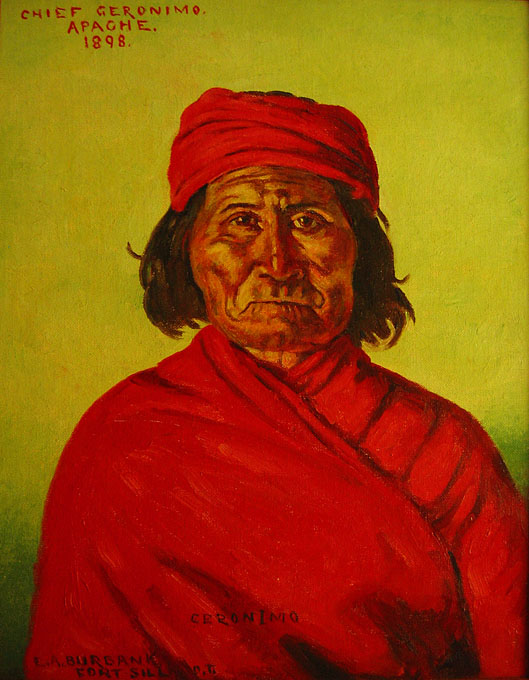
I think I was about 11 years old when my British and American ex-patriot grandmother took me along to an auction showing near where I lived in Cape Cod, Massachusetts. Since the auction itself was still a day away, the gallery opened up the back rooms for potential buyers to walk through and examine merchandise up close. There were rooms and rooms filled with antique treasures, most of which held no interest to me at that age. But I stumbled across a painting that mesmerized me. It was a portrait of Nde, or Chiricahua Apache Chief Geronimo, painted in 1898, 11 years before his death. The white Americans who don’t remember Geronimo as the last Indian leader to stage an armed uprising against the United States government, do tend to recognize his name as an epithet used when a cartoon character is about to do something stupid. In 1991 I didn’t know a thing about him.
When I looked at this portrait hanging before my eyes of a man cloaked in red with weather worn skin and an expression that shot to my core, I had a visceral reaction. I spent the better part of the afternoon held captive by the searching gaze of the man in this painting. The next evening, upon returning home from playing at a friend’s house, I saw the portrait hanging on the dining room wall the instant I walked through the door, but I said nothing. I played dumb in front of my dad and grandmother who subtly tried to direct my attention toward it. I think I was afraid I could be dreaming. I finally “noticed” it and cried with delight. The painting was more beautiful than ever, even to my young eyes.
In 18 years, the painting has never left my side. Today it hangs in my bedroom, surveying me, reminding me of things more important than my own life. In Geronimo’s eyes I see pain and defeat, I see ferocity, compassion, curiosity, and peace. I see warmth. I see the past and the land. Each time I glance at his portrait I sense something new.
One of the remarkable things about a valuable artifact like a painting is that it has history and I’m as mesmerized by the history of this particular portrait as I am of the work itself. Completed in 1898, it has over a hundred years of history, of which I have only been privy to the last eighteen. While the history of the specific canvas that hangs on my wall remains predominantly a mystery, I have discovered some interesting facts about the painter and his meeting with Geronimo in 1898, the least of which is that the painting I have is one of a handful of portraits of Geronimo – all by E. A. Burbank – ever created from a live sitting.
Elbridge Ayer Burbank grew up in Illinois during the mid-19th Century, born twenty-five years after the last tribes in the state had been exiled to the West. With youthful and artistic ambition (and a commission from the Field Museum in Chicago), Burbank set off to paint the great Native American figures of the time, capturing their plight from an anthropological perspective. Burbank wrote in his memoir, Burbank Among the Indians,
Having heard of Geronimo only through the screaming newspaper head-lines which exploited his daring raids and cruel massacres, I was prepared to meet a thoroughly bloodthirsty savage. I gave thanks that I did not have to encounter this crafty Apache at large, but instead could sketch him behind prison bars. Imagine my great surprise upon arriving at Fort Sill to find that Geronimo was not in prison at all but was allowed his freedom. He lived in a house the government had built for him, a one-story affair built around a patio.
Upon knocking on Geronimo’s door, Burbank was told that the chief was hunting. Burbank’s memoir picks up from here:
I sat down upon the steps and waited. Presently an elderly Indian came riding up on a horse and dismounted. He was short but well-built and muscular. His keen, shrewd face was deeply furrowed with strong lines. His small black eyes were watery but in them there burned a fierce light. It was a wonderful study, that face so gnarled and furrowed. I studied it as he came over to me. I offered him a cigarette and lighted one myself. We sat there and smoked for a while without saying anything. All this time Geronimo was peering at my face. He knew I had some further object in being there. Finally he asked me to tell him about Chicago.
Eventually Burbank roused the courage to address Geronimo about sitting for a portrait: “I am an artist. I also came to Fort Sill to paint a picture of Big Chief Geronimo.” Burbank later described:
I never had a finer sitter than Geronimo, although sometimes he became very nervous while posing. I would give him a few minutes rest until he quieted down. Invariably upon hearing a horse or footsteps, he would rush to the door and see who was coming. He seemed to have a haunting fear of being pursued, even though he was at the time a prisoner. As we worked day after day, my idea of Geronimo, the Apache, changed. I became so attracted to the old Indian that eventually I painted seven portraits of him.
Before his death in 1909, Geronimo confided that he liked Burbank more than any white man he had ever met.
Burbank went on to create over 1,200 portraits in 125 tribes. He died in 1949 when he was hit by a cable car in San Francisco.
Interestingly enough, Burbank wrote in his memoir that he painted seven portraits of Geronimo. Yet I have found several different paintings – plus my own – that are attributed to Burbank and clearly feature Geronimo. Perhaps I’m looking at different postings of the same paintings – some have very obvious similarities. I’ve included links to the other paintings below. As far as I know, mine is the only remaining painting that is not in a museum, while I suspect that there are sketches out there that I have not yet tracked down. Perhaps I’m biased, but I believe mine to be the best. It captures something for me I can’t describe that the others do not.
This link takes you to five of Burbank’s portraits of Geronimo. Two are housed in the Butler Art Museum in Youngstown, Ohio, two at the Newberry Library, in Chicago, and one at Bibliotheque des Arts Decoratifs, Paris, France. This latter portrait closely resembles mine and judging from some details, it appears both were created during the same sitting.
Similar to one of the Butler pieces, but with notable differences, is the version at the Smithsonian American Art Museum. And yet another with the same theme at the Eiteljorg Museum of American Indian and Western Art in Indianapolis.
At the Hubbell Trading Post in Ganado, New Mexico, is a painting and I’ve also seen a crayon sketch that supposedly is housed there. And finally, the painting that most mirrors my own. I can’t find where the original is, if it even exists. This copy was the cover page in the now out-of-print edition of Burbank’s autobiography, ”Burbank Among the Indians.”
What is most fascinating to me is that the story of this painting keeps evolving for me. Each time I research Burbank and his work I learn more that gives me glimpses into his painting that hangs on my wall. Surely the story will continue.
 Trevor Munhall
Leave a comment